Alcohol
In chemistry, any chemical compound that has a hydroxyl group (-OH) attached to carbon is an alkyl,
called alcohol. The general formula of a simple alcohol is the ring of CnH2n + 1. In chemistry,
alcohols are an important group of chemical compounds and are involved in a wide range of
reactions, and many chemical compounds are obtained from them, so Morrison and Boyd's organic
chemistry book suggests that if he tells a chemist he will have ten of his chemical compounds The
island will leave alone. Alcohol will be one of them
In general, when the name of the alcohol is used alone, it is usually ethanol, which is the alcohol
taken from barley or sweat, or alcohol. Earthenware ethanol is a very spicy liquid that can be
obtained from fermentation of sugars. Also, alcohol is sometimes referred to as any alcoholic
.beverage. For many thousands of years, alcohol is generally considered as an addictive factor
Other alcohols often come with special characteristics such as wood alcohol (which is methanol) or
.isopropyl alcohol. The word "Wolff" also comes to the end of the chemical name of all the alcohols
:Identification of Alcohols
Alcohols are neutral compounds. Of the other neutral compounds, aldehydes, ketones and esters.
Usually alcohols and esters do not respond positively to tests 2 and 4 - di-nitrophenylhydrazine, but
the result of this test is positive for aldehydes and ketones. Esters do not react with acetylchloride
reactors or Lucas reactants, but alcohols react with these two reactants. This makes it easy to
identify them from alcohols. The first and second types of alcohol easily oxidize, but the third type of
esters and alcohols are not oxidized. By performing two Lucas and Chromic Acid tests, it is possible
.to identify the first, second and third type alcohols
To identify alcohols, there are several tests that can be used to test; detect active hydrogen or test
sodium, test for ammonium hexa nitrate serum (IV) or test for ammonium nitrate, detect alcohol
alcohol by sterilization or sterilization test Chloride, Chromic acid or Jones test, xanthate formation,
Lucas test, N-bromo-succinimide test (NBS) and pendic acid test
Structure and categorization
Alcohols are classified into three types of the first, the second, or the third types, depending on the
type of carbon [4] that is linked to the OH group: in the image from left to right methanol, a type of
. alcohol is type 1, 2 and 3
General view of alcohol types
.Type I CR (H) 2-OH alcohol •
Type II alcohol C (R) 2H-OH. The •
.Type III alcohol C (R) 3-OH •
... ◦
:Physical properties
Boiling temperature
Alcohols have higher boiling points among hydrocarbons of their own weight, which can be called
.the hydrogen bonding of alcohols, which causes more energy to break their intermolecular bonding
Solubility
Due to the fact that the bond between the alcohols, such as water, is a hydrogen bond, dissolves to
any extent in water. Also, due to the fact that the alcohols, on the one hand, have an organic part
.and, on the other hand, a group of hydroxides, also dissolve many organic materials
.The iodine solution is said to be liquid and water-soluble and used for disinfection
Alcohol is characterized by normal conditions, volatile, flavorful, colorless or odorless. The chemical
physical properties of alcohol depend on the hydroxyl group (COH). Spectrographic studies show
that in the liquid state of hydrogen bonding between hydrogen, the hydroxyl group has a molecule
and oxygen of the hydroxyl group of the second molecule, but this transplant is weaker than the
hydrogen bond between the water molecule
:Chemical properties
.Ethyl alcohol has a chemical formula C2H5OH. It can be soluble in water at any rate
.Alcohol has the ability to dissolve different types of fats, which is used to clean surfaces
One of the most important properties of alcohol inhibition is that it has the ability to use alcohol in
.disinfection in medical practice
One of the most important properties of alcohol is burning it. Ethyl alcohol burns like other organic
: sodium test
One of the basic properties of the hydroxyl group is the formation of a hydrogen bond and the
chemical exchange of hydrogen. Hydrogen metal (especially freshly cut samples) easily reacts with
the hydroxyl group and releases hydrogen
.Note: Functional groups containing hydrogen in nitrogen and sulfur can also produce hydrogen gas
The acetylene compounds are also reacted with sodium. But the hydrogen gas does not show up,
because at the same rate as hydrogen, it enters an increasing reaction at the same speed of
hydrogen with double bonds
.Note: The presence of moisture within the composition also results in the exhaust of hydrogen gas
Error factors:
We need to make sure that the agent group is active because it may lack a functional group but will respond positively to the test.
Test tubing is not dry
The presence of impurities containing active hydrogen that provokes a positive test error.
Physical properties: liberated gaseous hydrogen
Chemical property: The presence of a hemogene attached to an electronegative atom
:)Ammonium nitrate test NH4 (2Ce (NO3) 6
The ammonium nitrate reagent compound with compounds having hydroxyl alcohol groups forms a
red complex. The test answer is positive for first, second and third type alcohols with less than 10
carbon. All types of glycols, polyols, carbohydrates, hydroxyl acids, hydroxylaldehydes, and hydroxy
.ketones respond positively to this test and produce a red solution
It should be noted that the formation of a red complex is an intermediate in the oxidation of alcohol
by the above reagent. The second part of the reaction involves the loss of red color and the
.))formation of a colorless complex (Ce (II
.Note: Aliphatic amines cause formation of a crystalline crystalline deposition of hydroxide
Chemical Properties: Oxidation
Converts Ce + 3 to Ce + 4 and forms a complex.
[NH4) ₂Ce (NO₃) ₆ + RCH₂OH → [Alcohol + Re]
[complex] → RCH₂O (radical) + (NH₄) 2Ce (NO₃) + + HNO₃ +
RCH2O + (NH4) 2Ce (NO3) 6 → RCHO + (NH4) 2Ce (NO3) 5 + HNO3
Physical Properties: Change the color of yellow to red
Error factors:
Ring-amines and amine hydrochlorids may also be oxidized to a ceramic ammonium nitrate oxide and produce or deposition
:)Acid Test (Jones Reagent
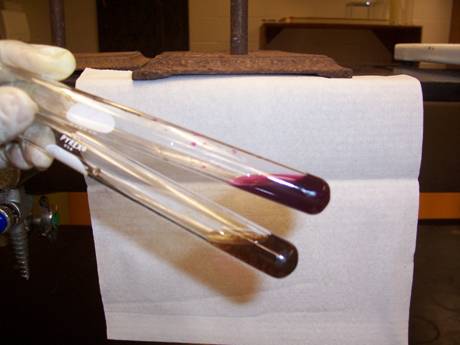
This reaction is used to identify and detect first and second type alcohols of type III alcohols, and is
based on the reduction of chromium (VI) yellow to orange to chromium (III). The alcohol is oxidized
by this reaction. The color change of the reaction from orange to green is a positive response to the
test. The first and second types of alcohol are converted to carboxylic acid and ketones, respectively,
.by the reaction
It should be noted that first-alcohol alcohols first convert to aldehydes and then to carboxylic acid,
.but in the case of type II alcohols that produce ketones oxidation is stopped
Note: The first and second type alcohols respond positively to chromic acid (Jones reagent) tests, but
.third-grade alcohols do not respond positively to this test
.)Note: Aldehydes also respond positively to the chromic acid test (Jones reagent
.Alcohol Type I: Fast, and as soon as the CS2 arrives, it precipitates
Note: Only the formation of sediment is considered, production of brown color does not cause
.sedimentation
Physical Properties: Change the red to green color
Chemical Properties: Oxidation
Error factors:
This test is very fast, if more than 2 seconds long, other compounds may be involved in the green. These compounds may include olefins, amines, ketones, anols, or phenols
Lucas Test:
.Lucas test for the detection of type III alcohols, allyl and alkali from first and second type alcohols
This test is based on the reaction of alcohols with a mixture of hydrochloric acid and zinc chloride
(Lucas reactor), which is an alkyl chloride product, which is an insoluble layer
Type I alcohols do not react at room temperature with the Lucas reagent, and therefore their
solubility is easy to see. Second-class alcohols respond slowly to Lucas's test, so that the test is
.considered to be negative. But third-grade alcohols, benzyl alcohol and allylic, react immediately
Physical Properties:
Non-solubility of the reaction product due to the conversion of alcohol to alkyl halide R_X (seeds
Oil on the surface of the solution) in an insoluble aqueous medium and forming an organic phase.
Substitution - Cl instead of OH=chemical properties
-
Complication:
In the
oxidant discoloration test, we find that the reaction is carried out, so if you do a lot of oxidation,
change the color and the color of the oxidant is mixed with it, and we do not notice the change in
color, and the miller is in error, so we should not use too much oxidant. The environment must have
sulfuric acid. Sulfuric acid increases the oxidation of chromium, and we can quickly conclude that the
role of acetone is that the chemical reaction must be homogeneous so that the raw materials are
combined. Most of the chemical reactions are carried out inside the solvent, Let's choose a solicitor
to get it all If you do not get an acetone, many of the leukulas may not be solved first in the
environment so that the alcohol becomes milky
In the sodium test, the test tube should be dry, and if sodium is not reacted with water in the environment, then the test will fai






















.jpg)


.jpg)
.jpg)